How Uniting Used Responsible AI to Reduce Administrative Burden and Improve Care
Where responsible AI begins: with the needs of workers and the people they aim to support
Uniting NSW.ACT presented their AI story at Infoxchange's 2026 Technology for Social Justice Conference. This use case was developed from their team, and not directly through Infoxchange's services or programs.
Uniting NSW.ACT exists to provide community services, spiritual care, social justice and advocacy to build a better future for more people and communities by disrupting entrenched disadvantage. Across NSW and ACT, Uniting supports more than 156,000 people through aged care and community services. Day-to-day support includes enhancing support for seniors, particularly those experiencing social and economic exclusion.
More than 11,000 employees and 1,300 volunteers face increasing pressure to respond to community need. More than 32% of the people they serve speak languages other than English. Digital Innovation Lead Jonalyn Esquerra, also known as “Jowe”, led the task of identifying a way to assist frontline staff who effectively had two jobs: firstly, caring for people, and secondly, managing information across disconnected systems.
When investigating how technology could provide assistance to an overburdened sector, the question was never simply, “how can AI help?” The question was how the team can reduce administrative complexity for frontline workers so they can spend more time caring for people.
This human-centred question became the foundation for Buddy – an AI-powered digital assistant designed to support aged care and community service staff across the organisation. Before attending their very first client visit of the day, Uniting staff were logging into multiple systems, piecing together information and navigating the cognitive burden of duplicated administrative processes. Jowe’s team spent extensive time travelling with frontline workers, observing their daily experience directly.
“We recognised that time was one of the sector’s most constrained resources,” Jowe shared, highlighting that the problem was not staff failing to deliver effective care, her team observed the real issue they identified was how staff were able to access information, and capture information across these systems throughout the day. The team focused on some fundamental questions:
-
How could they reduce the cognitive burden?
-
How could they reduce memory bias?
-
How could they meet staff at the ‘point of care’?
-
How could they make information capture easier and more immediate?
This led to an initiative of redesigning the administrative systems and the flow of information around frontline staff.
The goal became fixing the complexity of admin burden to technology so that staff could focus on what mattered most: providing care.
This human-centred question became the foundation for Buddy – an AI-powered digital assistant designed to support aged care and community service staff across the organisation.
Building Buddy: an AI-enabled digital front door
The outcome of this work was Buddy – Uniting’s AI-enabled digital assistant and “digital front door”. Rather than being a standalone chatbot, Buddy was designed as a practical operational layer connecting workers to the systems, information and workflows relevant to their role.
Buddy included three core capabilities:
-
Personalised digital front door
Buddy used role-based access controls so staff could quickly access the systems and applications relevant to their role and responsibilities.
As Jowe explained, “Buddy knows who you are in the organisation”, making it easier for staff to navigate operational systems without unnecessary complexity.
-
AI-assisted policy search
The platform integrated AI chat functionality connected directly to Uniting’s official policy and procedure environment. This was particularly important because the organisation managed approximately 1,200 policies and procedures stored across SharePoint environments. Rather than forcing workers to manually search lengthy documents, Buddy summarised policy information into concise and actionable responses.
-
AI transcription and progress notes
Buddy also introduced AI-powered transcription and note capture capabilities designed for multiple workforce personas and workflows. This enabled frontline workers to dictate progress notes verbally and integrate them directly into care systems in real time, which became particularly valuable for workers who struggled with written documentation or experienced barriers such as dyslexia.
Designing responsible AI from the beginning
One of the most significant aspects of the Buddy initiative was the amount of preparation completed before deployment. Jowe explained that the journey began approximately three years earlier and focused heavily on governance, risk management, infrastructure readiness and organisational preparation. This preparation phase was not described as a technology implementation exercise to staff. Instead, it was framed as building the organisational foundations required for responsible AI adoption.
-
Governance and risk management
Rather than attempting large-scale deployment immediately, Uniting first partnered with Microsoft on a proof of concept and executive showcase, allowing the organisation to start small, test operational use cases, explore practical implementation scenarios, build executive understanding and establish organisational support before scaling. Incorporating governance and safeguards from the beginning was developed in tandem with technical development. Implementing Uniting’s first AI policy was key before any form of implementation.
“We needed to ensure that the infrastructure to support the solution was secure, and that we had governance and guardrails built into the tech, embedding it into the design and rollout approach from the beginning,” Jowe shared.
-
Data readiness and remediation
Data readiness was a critical focus throughout the three-year preparation period. Emphasising that responsible AI depends on reliable information foundations, Jowe echoed that “garbage in equals garbage out”, and that the team needed to assess the quality of its information environment and identified areas requiring remediation before scaling AI-enabled workflows.
“You need to make sure you have ‘data readiness’ and if you identify any gaps, you need to be quick to plan your data remediation activities to set you up for success later on.” Inaccurate, inconsistent or poorly governed data could undermine trust in AI outputs, particularly in care environments where documentation quality is key.
The team also recognised that operational complexity could not be solved through isolated technology deployments alone. Throughout the 3-year process, Uniting extensively reviewed their infrastructure sustainability, architectural structures, their workforce capability to improve data readiness, organisational resources, and long-term scalability, confirming that “you need to look at the infrastructure as an ecosystem, not just in silos,” Jowe shared.
-
Human oversight and multilingual inclusion
Another key feature of Buddy’s design was its emphasis on human oversight and workforce inclusion, with their platform incorporating multilingual capabilities across all the three major functions. Uniting reviewed workforce language demographics and focused on the top seven languages spoken by staff, including Nepalese as the largest language cohort. The organisation also partnered with language subject matter experts to ensure translations remained concise, accurate and operationally useful.
Within the transcription workflow, Buddy introduced what Jowe described as “user friction” – intentionally slowing the process to ensure human verification remained part of the workflow.
Staff could:
-
view the original language used
-
review English translations
-
validate the AI-generated output
-
confirm accuracy before submission into care systems.
Once approved, the information integrated directly into care systems in real time and remained traceable and trackable. This “human in the loop” design ensured AI supported professional judgement rather than replacing it.
-
Change management and trust
Jowe repeatedly stresses that “trust matters,” and her team recognised early that AI adoption would depend as much on workforce confidence as technical capability. The organisation invested heavily in co-designed workshops, operational engagement, digital literacy, AI literacy, change management and frontline training. Regional teams were deliberately prioritised during rollout after feedback that non-metropolitan teams often felt excluded from transformation initiatives. The implementation included three months of training and hands-on support to help staff understand the purpose of the technology and how it would support their work.
Importantly, Uniting also engaged openly with fears around AI replacing jobs or disrupting long-established professional practices.
As Jowe recalled, frontline staff would ask:
“Is AI going to replace my job?”
“You’re asking me to unlearn 30 years of nursing note taking?”
Rather than dismissing these concerns, the organisation focused on listening and involving staff directly in the journey.
As Jowe explained:
“Trust doesn’t start when you release a solution. Trust starts when you actually include them in the journey.”
How Buddy has amplified frontline workers’ ability to provide timely support
The implementation of Buddy produced measurable operational improvements across frontline and administrative teams.
Uniting NSW.ACT reported:
-
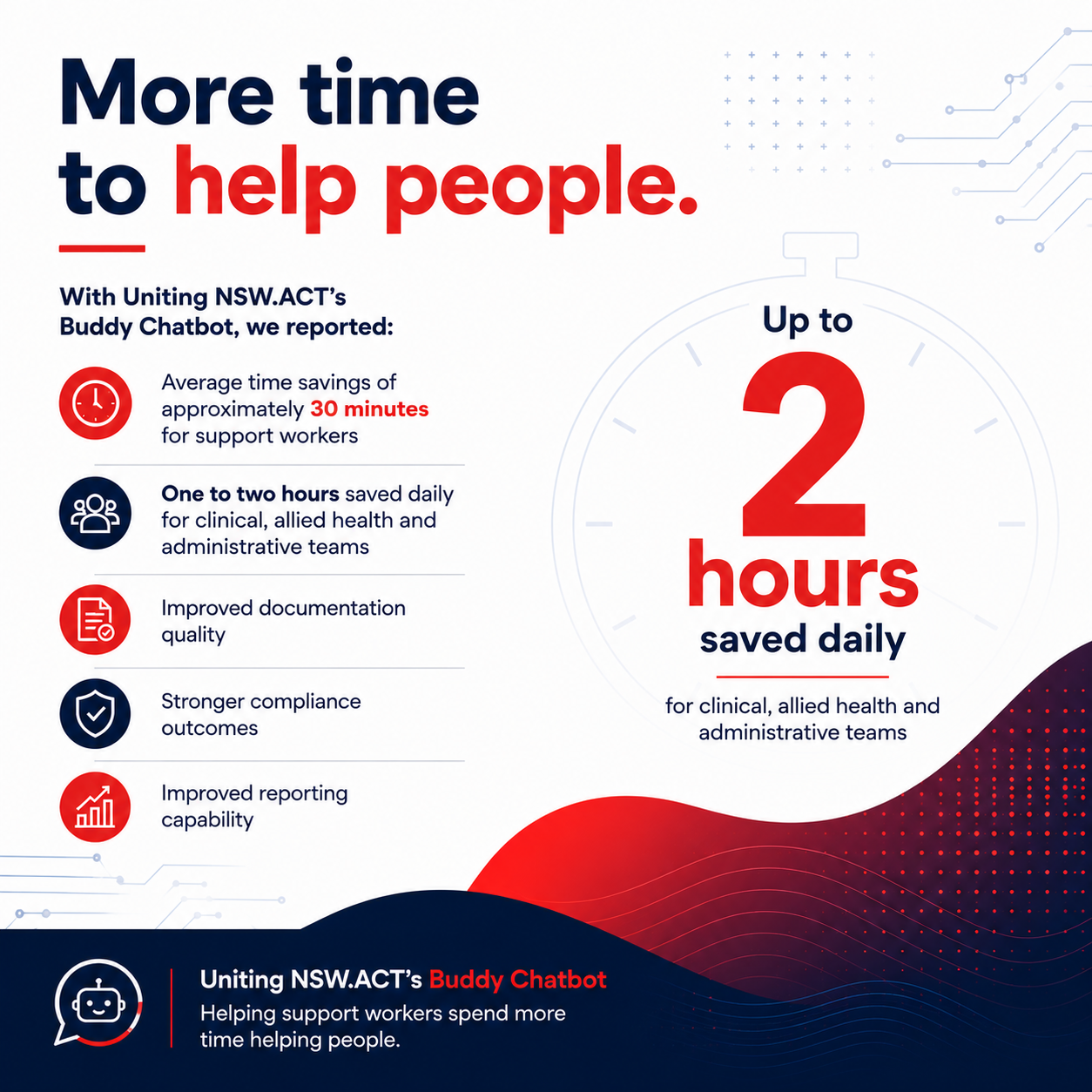
average time savings of approximately 30 minutes for support workers
-
one to two hours saved daily for clinical, allied health and administrative teams
-
improved documentation quality
-
stronger compliance outcomes
-
improved reporting capability
-
increased confidence among staff who previously struggled with documentation.
The organisation also observed improvements in information accessibility and workflow efficiency across systems.
Uniting is continuing to expand Buddy into residential aged care and mental health services while integrating with additional clinical systems. Future implementations of Buddy will include AI-assisted summarisation of incidents and progress notes, enhanced visibility for clinical teams, integration with sensor technologies, and exploration of predictive care capabilities.
For Uniting, responsible AI implementation is not simply about deploying tools faster. Success of implementation is dependent on governance, data readiness, trust, human oversight and designing technology around the realities of frontline care work.