


Road to the Conference: Agents and Sector Optimism with Dheeren Velu, Head of Innovation at Capgemini
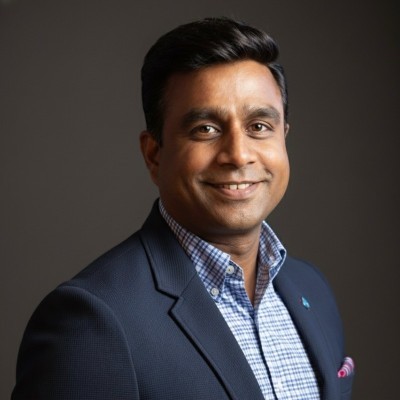
As part of our Road to the Conference series, we spoke with Dheeren Velu, Head of Innovation at Capgemini, about the next wave of AI and what it means for the not-for-profit sector. Drawing on two decades advising organisations globally, Dheeren unpacks the rise of the agent economy, where AI moves from assistant to autonomous actor, and why NFPs must shift from passive observers to active shapers of this rapidly evolving landscape. Dheeren wil be delivering a keynote on Day One at the Technology for Social Justice Conference titled, "Expert Insights and Cutting Edge Innovations on AI.
What are the most important shifts in AI that not-for-profits should be paying attention to right now?
Three shifts:
- The first is the Agent Economy. AI is moving from assisting humans to acting autonomously on our behalf. Within 4-5 years, AI agents are projected to outnumber the entire human internet population. The future participant in the internet is not a person - it's an agent. If your organisation isn't visible and credible to those agents, you won't exist in their decision-making.
- The second is hyper-personal AI - A shift from AI as a tool you pick up and put down, to AI as a dedicated system that executes within your values, continuously, around the clock. For lean not-for-profit teams, this is a genuine capacity multiplier.
- The third is Autonomous Decision Agents - AI systems that don't just surface options but make decisions within human-defined guardrails. This has profound implications for fairness and equity in how resources are allocated, and it's being built right now.
Where do you see the biggest gap between what AI can do today and how organisations are actually using it?
The gap isn't technical - it's mostly organisational. And it's bigger than most leaders realise.
Across the enterprise broadly, the most common failure is getting stuck between pilot and production. Organisations run proofs-of-concept (POC) , see promising results, and then stall. The blockers are rarely the technology.. they're organisational inertia, skills shortages, and the hard work of redesigning processes that nobody wants to touch.
AI capabilities like Agentic Systems and Generative models can handle genuinely complex, autonomous workflows today. Most organisations are still using them as glorified chat assistants.
The disconnect that I find most striking though, is between individual productivity and company-wide gains. AI super-users are reporting five times productivity gains.. real, measurable, extraordinary improvements in their own output. But organisations aren't capturing it. If a worker completes a task in two hours instead of eight, and the workflow around them hasn't changed, the result is slack time, not transformation. The individual got faster. The organisation didn't. Closing that gap requires deliberate process redesign, and most organisations haven't done it.
There's also a strategic missed opportunity hiding in plain sight. AI is increasingly capable of creating entirely new revenue streams, through hyper-personalisation, new product discovery, dynamic service delivery. Yet only around 20% of organisations are using AI to grow revenue. Majority are still in efficiency mode, focused purely on cost reduction. That's leaving an enormous amount of value on the table.
For not-for-profits specifically, the equivalent isn't revenue, it's reach, impact, and the ability to serve communities that current resourcing simply can't get to. That's where the real frontier is.
Why are agentic AI and agent economies important for NFP leaders, and what will you cover in your keynote?
Because the internet itself is being restructured around Agents, and most not-for-profit leaders don't know it yet.
Right now, the payment and commerce infrastructure being built underneath the agent economy, protocols that let AI agents transact with each other in real time, for fractions of a cent. It is creating an entirely new layer of the web. One where donor agents will decide which causes deserve attention, which organisations have credible impact, and where to direct resources. Without a human ever making a conscious choice.
In my keynote I'll cover what this actually means operationally. How to ensure your organisation is discoverable and credible in an agent-driven world, alongside the immediate, practical AI applications your teams can use right now, and the more frontier concepts like autonomous decision agents and digital brain modelling that will define the next five years.
What gives you optimism about AI's role in creating more equitable and impactful organisations?
What gives me optimism is this sector specifically.
I've advised governments, boards, and executives across industries and geographies for over two decades. I've seen AI adopted well and adopted badly. The difference almost always comes down to whether the people driving it had a genuine value system behind it - or just a business case.
Not-for-profit organisations have something the technology sector genuinely lacks: deep, lived expertise in what fairness looks like in practice, hard-won trust with the communities they serve, and a mission that puts people first by design. When those organisations engage seriously with AI.. not cautiously, not reactively, but intentionally, the outcomes are extraordinary. The tools are more powerful than most leaders realise. In the right hands, they amplify impact in ways that were simply not achievable five years ago.
If attendees walk away with one mindset shift, what do you hope it is?
Stop thinking of AI as something happening to your sector and start thinking of it as something your sector should be shaping.
The infrastructure of the AI economy is being built right now. The guardrails are being set. The values being encoded into these systems will determine who they serve and who they overlook. The not-for-profit and social justice sector has the expertise, the perspective, and frankly the moral authority to influence that - but only if it chooses to engage. The organisations that move with intention now, even at small scale, will be in a fundamentally different position in three years' time.
That's the shift. From observer to shaper.