

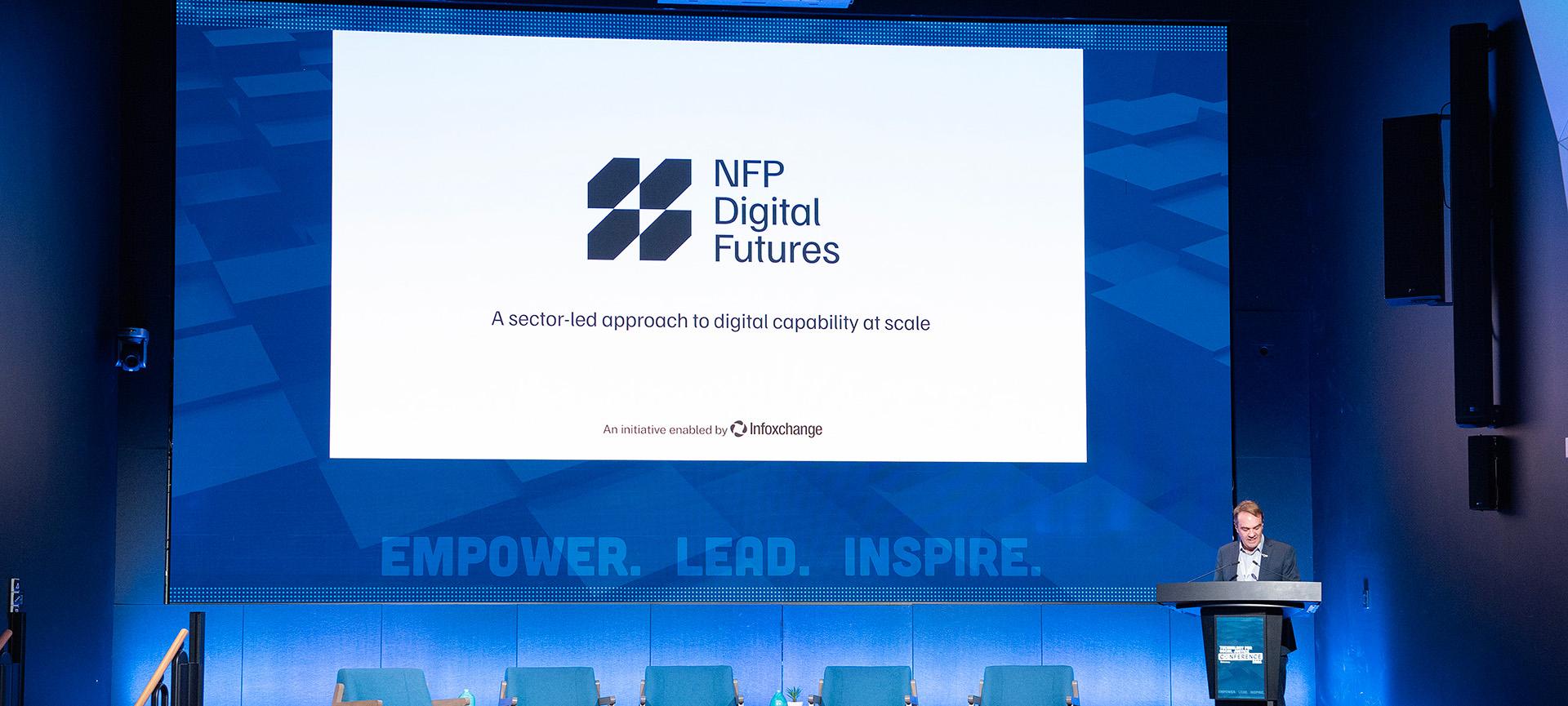
Major cross-sector collaboration launches to build digital capability in Australia’s not-for-profit (NFP) sector
Launched at Infoxchange’s Technology for Social Justice Conference, NFP Digital Futures is a national, sector-led initiative bringing together philanthropy, government, NFP organisations, peak bodies, and industry partners to strengthen digital capability across Australia’s NFP sector, enabling organisations to better deliver on their purpose and support the communities they serve.
NFP Digital Futures will operate as a coordinated, sector-wide mechanism to build digital capability at scale, delivering capability uplift programs, enabling shared tools and infrastructure, and aligning cross-sector expertise. It will focus on strengthening core digital foundations, cyber security, data capability and responsible artificial intelligence (AI) adoption, while reducing duplication and enabling organisations to access the support, skills and technology they need to operate effectively and focus more of their time and resources on delivering impact for communities.
The initiative has been co-designed over the past 18 months with the NFP sector, in response to the Federal Government’s NFP Sector Development Blueprint and the growing need to strengthen digital capability.
This work has been led by Infoxchange in collaboration with PwC Australia’s Impact Assembly, and supported by more than 35 organisations across the not-for-profit, government and industry sectors, including the National AI Centre (NAIC), Microsoft, Cisco, ARC Centre of Excellence for Automated Decision-Making and Society (ADM+S), Melbourne Social Equity Institute, Community Council for Australia (CCA), Australian Council of Social Service (ACOSS), Australian Charities and Not-for-profits Commission (ACNC), Social Ventures Australia (SVA), The Smith Family, Alannah & Madeline Foundation and Justice Connect.
With $16 million in early funding secured, the initiative is supported by leading philanthropic, government and industry partners, including Greater Melbourne Foundation, Paul Ramsay Foundation, The Ian Potter Foundation, Minderoo Foundation and Gandel Foundation, alongside contributions from the National AI Centre and technology partners such as Microsoft, PwC Australia and Okta. This forms the foundation of a broader ambition to mobilise up to $50 million to support sector-wide digital capability uplift, with further partners and investment to be secured as NFP Digital Futures moves into its next phase of delivery.
Together, this investment will strengthen digital capability across foundations, cyber security, data and AI enabling NFPs to support communities more effectively through innovation.
“This is about building the foundations for a stronger, more capable NFP sector,” CEO of Infoxchange, David Spriggs said.
“When digital capability is embedded across the sector, organisations can operate more safely and efficiently, reduce administrative burden and focus more of their time and resources on supporting communities.”
“Over time, this is what enables a more connected, trusted and sustainable sector – one that can respond in new ways to rising demand and continue delivering impact at scale.”
The collaboration builds on Infoxchange’s existing digital capability initiatives – including the Digital Transformation Hub, Data Catalyst Network and AI learning community – which have supported NFPs in strengthening their cyber, data and digital capabilities over recent years.
Assistant Minister for Productivity, Competition, Charities and Treasury, the Hon Andrew Leigh MP, said the initiative is a critical step forward for the sector.
“Charities are there when Australians need a hand. NFP Digital Futures will help them spend less time wrestling with clunky systems and more time helping people. The NFP Sector Development Blueprint set out projects for government, philanthropy, and the charity sector to deliver in order to boost capability in the for-purpose sector. NFP Digital Futures is exactly the kind of practical support that brings us closer to the Blueprint’s goal.”
A recent report by Infoxchange underscores the urgency of this initiative, highlighting that budget constraints, funding pressures and rising operating costs are limiting the sector’s ability to deliver critical services. The report found:
- Data and reporting for evidence-based decision-making have emerged as the top priorities for NFPs, increasing from 17% in 2023 to 44% today. At the same time, 25% of organisations cite a lack of data and analytics skills as a key barrier.
- AI adoption is growing but the number of organisations with an AI policy or guideline in place is alarmingly low, at just 14%.
- Progress towards a cyber-safe sector is stagnating or even regressing. Only 23% of NFPs have a documented cyber security plan in place, and fewer than half of those with 150 staff or less have effective processes to manage information security risks.
With one in 10 Australians employed in the NFP sector and 3.2 million volunteers contributing more than 320 million unpaid hours annually, NFPs have been unable to sustainably invest in technology – leaving them vulnerable as demand for services grows.
PwC Australia’s Chief Sustainability Officer John O’Donoghue said NFPs face the dual challenge of adapting to new technologies while continuing to deliver essential services.
“NFP Digital Futures aims to address these challenges head-on. It establishes trusted technology and AI foundations to enable responsible and safe innovation – helping organisations save time and money while focusing on delivering greater impact for communities,” Mr O’Donoghue said.
The initiative also builds on a partnership with the National AI Centre to support safe and responsible AI adoption across the sector.
By 2035, NFP Digital Futures aims to help build a NFP sector where digital capability is embedded, equitable and trusted, enabling organisations of all sizes to deliver more accessible, coordinated and human-centred services for communities while supporting a more adaptive and forward-looking sector that can respond to disruption, harness digital transformation and lead through change to meet rising community need.
NFP Digital Futures is now inviting NFPs, philanthropy, technology partners and sector leaders to help shape and support the next phase of delivery.
Organisations can get involved through a range of pathways, from capability uplift programs to communities of practice and sector-wide initiatives.
To explore opportunities and register your interest, visit nfpdigitalfutures.org.au.
ENDS
Additional Supporting Quotes
“This is not a project about technology or even the capacity of charities and NFPs, it's actually about enabling us all to better serve our purpose and our communities. Ignoring the benefits technology can bring is not an option.”
David Crosbie, CEO of Community Council Australia
“Not-for-profits are being asked to do more with less, while navigating increasingly complex legal and regulatory requirements. Without strong digital capability, that pressure pulls time and resources away from communities and makes it harder to meet people when and where it matters most.
NFP Digital Futures recognises these challenges are system-wide, and that lifting capability at scale requires coordinated, cross-sector collaboration. Strengthening digital capability is no longer optional – it is essential infrastructure for not-for-profits to operate with confidence and focus their resources where they have the greatest impact.”
Chris Povey, CEO of Justice Connect
"NFP Digital Futures clearly demonstrates how our Sector is leading the way in implementing the NFP Blueprint. When community service organisations strengthen their digital capability, they deliver even greater impact in communities across the country. Critically, they can also improve the digital inclusion of people experiencing poverty, disadvantage and hardship."
Cassandra Goldie, CEO of Australian Council of Social Service (ACOSS)
“Strengthening digital and AI capability across the not-for-profit sector is critical to ensuring organisations can continue to deliver high-impact, community-led services. As part of Microsoft’s broader commitment to help skill three million people in AI across Australia, initiatives like NFP Digital Futures show what’s possible through partnership – bringing together government, philanthropy, industry and the community sector to enable scalable, long-term capability uplift.”
Tim Allen, AI National Skills Director – ANZ, Microsoft Elevate
“Digital capability is essential for-purpose organisations. NFP Digital Futures recognises that this challenge must be met collaboratively and ethically, and that coordinated, long‑term investment is critical to building a more resilient and effective sector that supports families and communities to thrive.”
Professor Kristy Muir, CEO of Paul Ramsay Foundation
About Infoxchange
Infoxchange is a leading not-for-profit (NFP) social enterprise that has been delivering technology for social justice for 35 years. We tackle the biggest social challenges through the smart and creative use of technology.
We work with community, government and corporate partners to solve issues around homelessness, family violence, mental health and disability, as well as supporting families, women and young people, and First Nations communities.
Our products and services are used by over 38,000 government and community services. We provide the right tools to improve efficiency and deliver greater impact. Through our work in digital inclusion and social innovation, we use technology to empower people experiencing disadvantage, drive social inclusion and create stronger communities. We believe no one should be left behind in today’s digital world.
We are Australia and New Zealand’s leading NFP dedicated to using technology to improve the lives of people experiencing disadvantage and the organisations that support them.